
The challenges of integrating nanoparticles into chemiresistive gas sensors
By: Maryam Sadeqi
The Power of Nano
Over the past six decades, nanomaterials have gained significant attention for the unique properties that stem from their tiny size, in the range of a billionth of a meter. Scientists have gotten very creative in the ways they tune nanoparticle properties by manipulating their sizes, shapes, formulations, and the many ways in which they can be combined with other materials. This led to the development of many new functional materials for applications ranging from battery materials to anti-counterfeiting ink or cancer diagnostics.
Hybrid Nanoparticles for Gas Sensing: Our Technology
At Nano Hybrids, we develop hybrid metal/metal-oxide nanoparticles (NPs) for gas sensing and biotechnology. Our NPs consist of a metal core (the center) protected by a metal-oxide shell (the outer layer). The oxide shell can be functionalized with various organic molecules, to enable their integration in devices or ensure biocompatibility. Our advanced core-shell nanoparticles can offer advantages in gas sensing such as faster data acquisition, improved selectivity, chemical stability, and integration. We are currently investigating the real potential of our advanced nanoparticles for gas sensors. Our patented production method relies on a single solvent-free synthesis step to produce our advanced nanoparticles. Our current portfolio comprises zinc, iron and nickel-based NPs, but our production technology is compatible with almost any metal and oxide.
Why Nanoparticles Can Improve Gas Sensors
In this blog article for the month of May, we are focusing on the challenges of integrating nanoparticles into chemi-resistive gas sensors. This type of sensor detects gas by measuring a change in electrical resistance that occurs when the sensing material interacts with the gas molecules.1
Commercially, most sensing materials are made up of (bulk) metal oxides or conductive polymers. As mentioned in our previous article, the high surface-to-volume ratio and altered electronic effects of nanoparticles enable a greater number of favored interactions between the materials and target gases. This renders a potential for novel gas sensors that are more sensitive, selective, have a shorter response/recovery time and are able to sense at room temperature.
The Challenge of Integration: Formulating the Nanoparticle Ink
To incorporate nanoparticles into a gas sensor, inks can be used to e.g. dropcast onto an interdigitated electrode (IDE), forming a thin layer of NPs embedded on the surface of the electrodes (see figure 1). An ink is simply a carrier of an active compound immersed in a liquid. In our case, that is a high concentration of nanoparticles (B in figure 1). This ink needs to provide chemical and physical stability for the NPs over time, and be compatible with the method of deposition/materials. Stabilizing a high concentration of NPs is a challenge without the right surface molecules (known as ligands) and other additives such as binders, conductive polymers, or charge stabilizing agents that ensures the ink is stable and functions correctly.
To successfully drop-cast onto IDEs, the ink must meet several requirements:
- It has to ensure homogeneous dispersion of the NPs on the surface.
- It has to wet the surface well.
- It must not damage the substrate and electrodes.
- It must evaporate fast at ambient conditions.
- It must provide mechanical stability to the NPs on the electrode afterwards.
- It has to be porous or not fully cover the NPs, so their surface is readily accessible to the target gas.
- It has to provide good contact between the NPs and the electrodes.
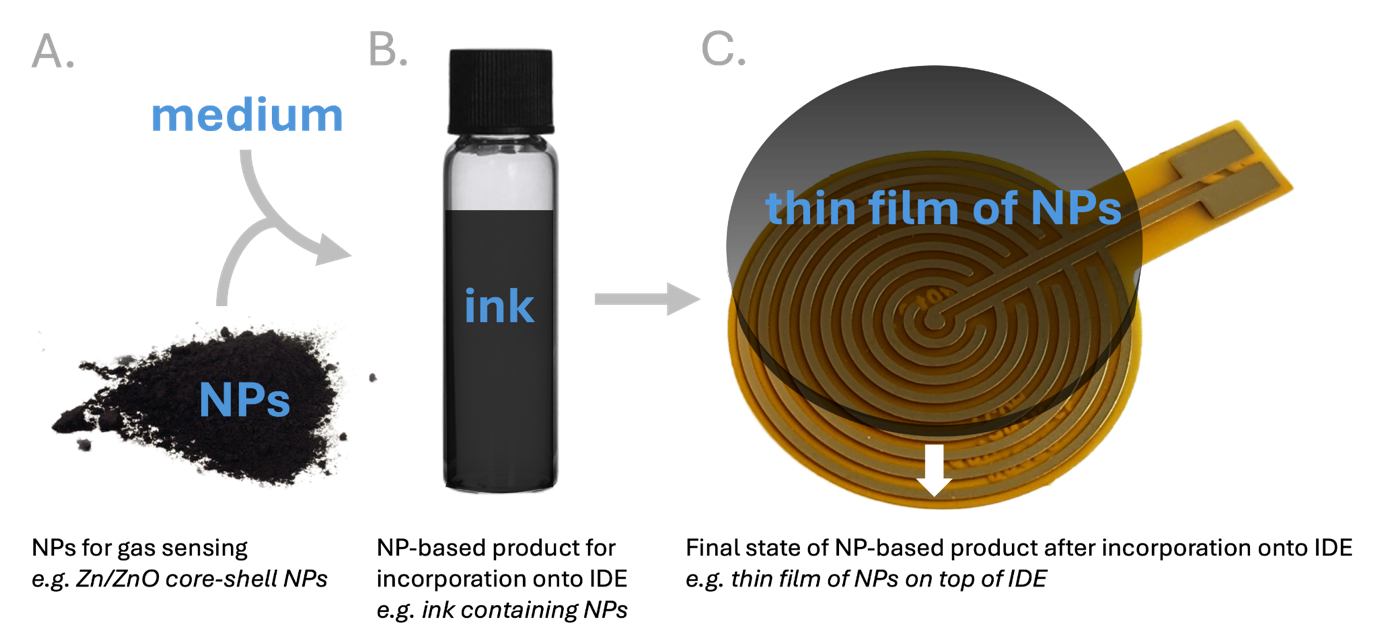
Figure 1. Schematic representation of the steps required to integrate nanoparticles (NPs) onto the Interdigitated Electrode (IDE) of a gas sensor, via an ink.
Other Ways to Incorporate Nanoparticles
There are other ways to incorporate nanoparticles into gas sensors, and each method has its advantages and disadvantages, such as those listed below in Table 1.
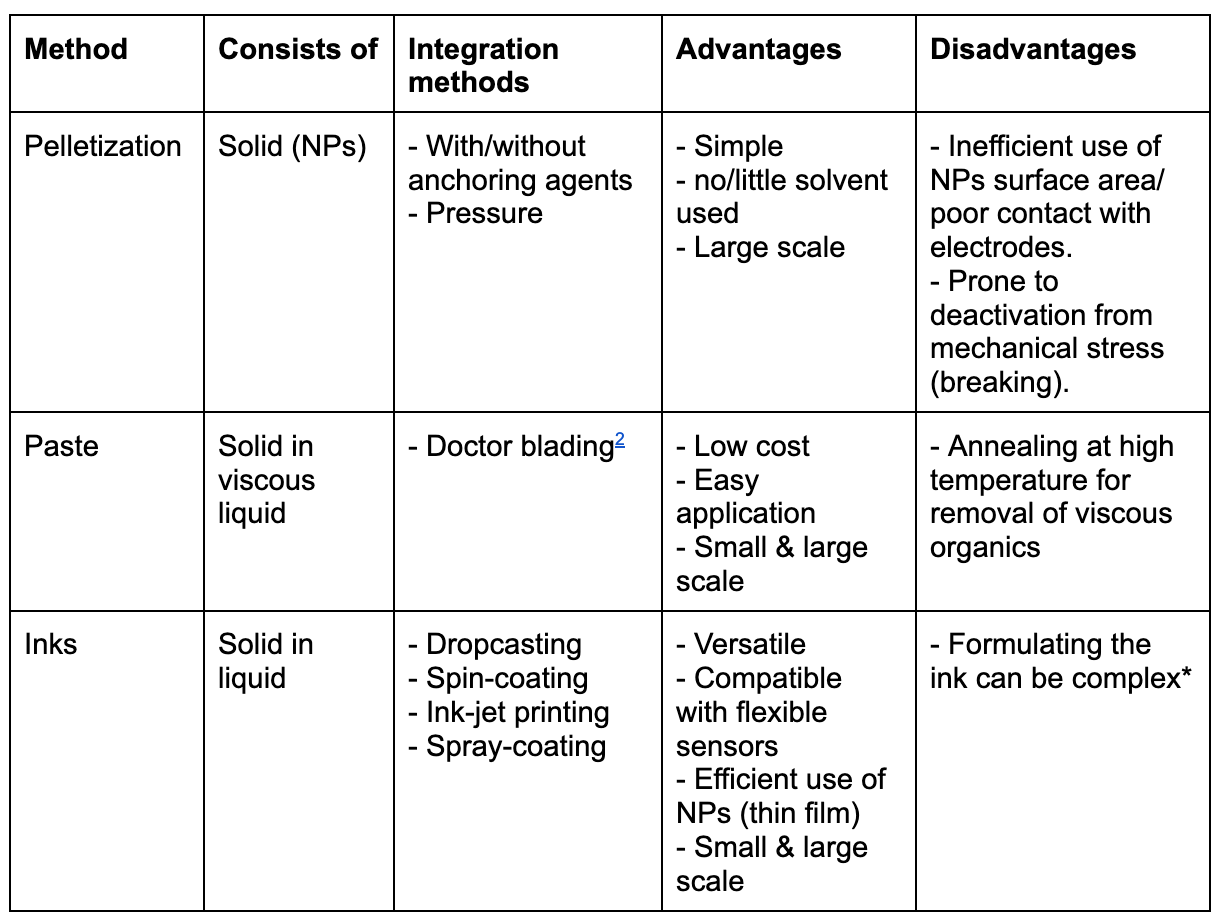
Table 1. Overview of common methods for the integration of nanoparticles onto electrodes
* For example, with inkjet-printing one is constrained to certain solvents and the ink has to have the right viscosity and surface tension for it to be printable.3
The Road Ahead: Challenges and Dynamics in a Novel Field
All in all, why is it hard to incorporate nanoparticles into chemiresistive gas sensors? Since it is a novel technology, and the properties of nanoparticles can be very diverse, the most effective and scalable method to incorporate NPs into existing gas sensors is not well-established yet. Furthermore, the environmental and health effects of nanoparticles are not well-known, meaning regulations might change and become more strict. This implies that we need to be dynamic in terms of the R&D, and keep many factors into account in the development of commercial nanoparticle-based gas sensors, which can be time-consuming.
We tackle these challenges daily at Nano Hybrids. Has this article sparked your interest? We are happy to explore opportunities and discuss ideas. You can contact us through the form or email at maryam@nano-hybrids.com.
References
(1) An Introduction to Metal Oxide Sensors. Ossila. https://www.ossila.com/pages/metal-oxide-sensors%20 (accessed 2026-05-01).
(3) Arrabito, G.; Aleeva, Y.; Pezzilli, R.; Ferrara, V.; Medaglia, P.G.; Pignataro, B.; Prestopino, G. Printing ZnO Inks: From Principles to Devices. Crystals 2020, 10, 449. https://doi.org/10.3390/cryst10060449